Install mapping resources
Once you receive a Bing key, place map resources in a Maps folder created in the appropriate location. You'll find the Maps folder in one of the following locations:
Note
You need to create the appropriate Maps folder when adding online mapping to a FastStats system, if not already in place.
- On the web server in …\FastStats\Maps, if using the Apteco FastStats Launcher
- On the user's PC in …\Program Files\Apteco\FastStats Discoverer (x64)\Maps, for a locally installed Apteco FastStats connecting to a local system (i.e. using a
.system.xmlconnection file such as when launched from FastStats Designer) - On the user's PC in …\Program Files\Apteco\FastStats Discoverer (x64)\Maps, for a locally installed Apteco FastStats connecting to an Enterprise system (i.e. via the FastStats WebService)
Note
The [SystemName] subfolder is necessary to enable separation of user IDs between systems.
If you purchase one or more Bing keys, you receive a 64 or 128 character string for each named user. You need to store these keys in a file called Bing.key in the appropriate Maps folder. Each line holds one key, containing [user-id][tab][key]. A tab character separates the user ID and Bing key, and neither needs angle brackets. See an example Bing.key file below (with fictitious content):
1   1234567890AaBbCcDdEeFfGgHhIiJjKkLlMmNnOoPpQqRrSsTtUuVvWwXxYyZz12
3   AaBbCcDdEeFfGgHhIiJjKkLlMmNnOoPpQqRrSsTtUuVvWwXxYyZz1234567890XX
6   JjKkLlMmNnOoPpQqRrSsTtUuVvWwXxYyZz121234567890AaBbCcDdEeFfGgHhIi
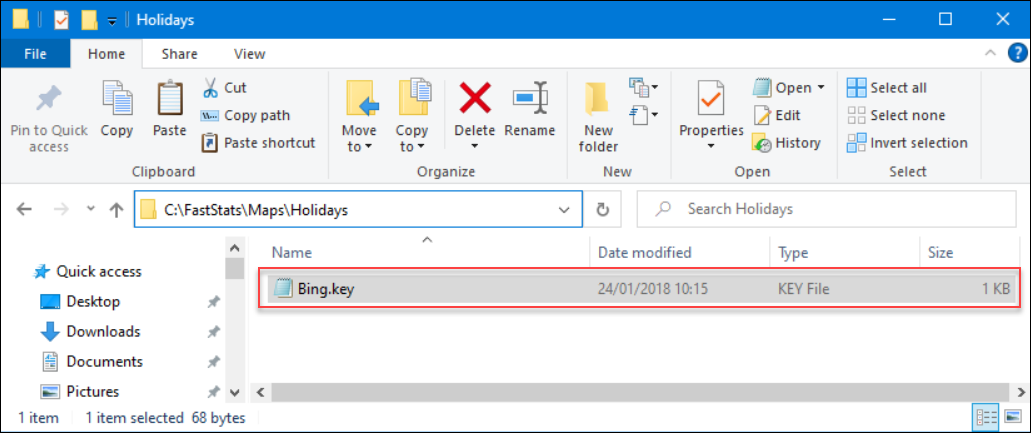
This process is also required for making use of the OpenStreetMap resource. You aren't provided with a Bing key, but you need to create a Bing.key file and place it in the same folder mentioned earlier. This is necessary to make the Mapping Module available in Apteco FastStats. Here is an example OpenStreetMap key, which you can use in any system that has purchased a Geo licence:
Inserting the Bing key into binaries
Once you save the file in the correct directory, add Bing.key into the Apteco FastStats Binaries in the FS_Config database (Launcher users only):
-
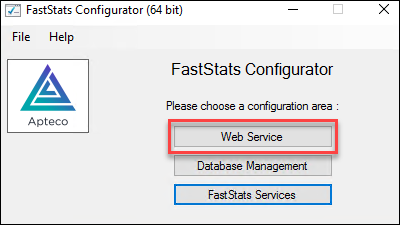
Open the FastStats Configurator and select the Web Services button.
-
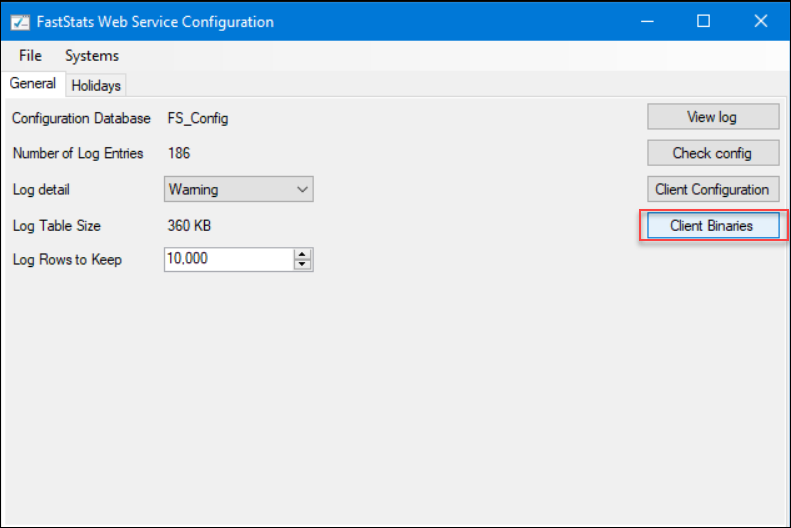
Select the Client Binaries option.
-
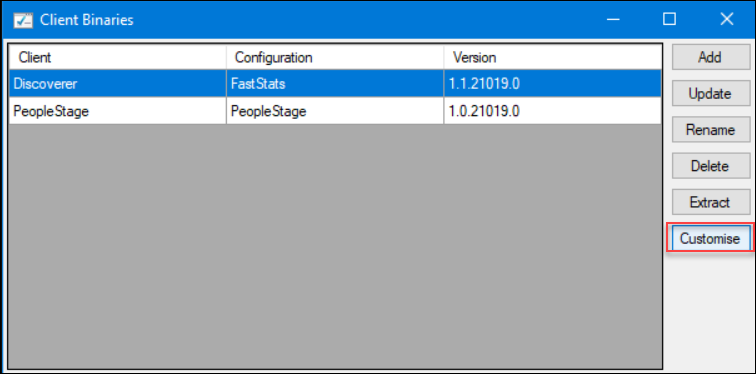
Select the FastStats Discoverer configuration and then select Customise.
-
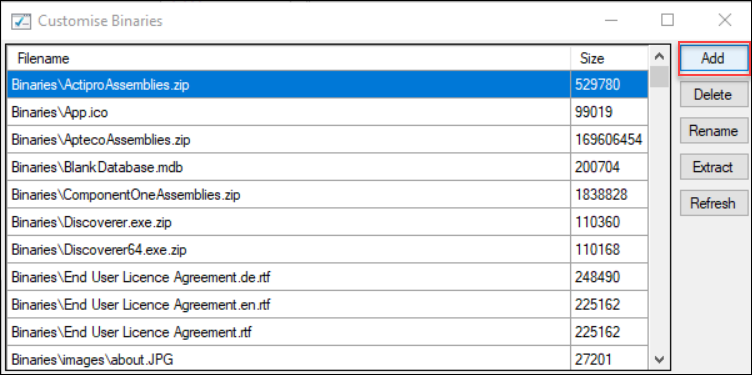
Select Add in the Customise Binaries window.
-
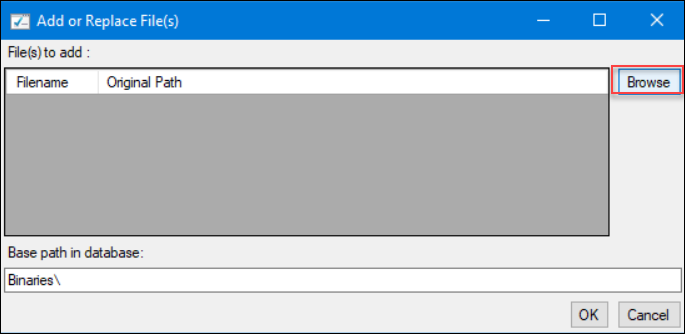
Via the Add or Replace File(s) menu, browse to and double-click the Bing.key file.
Note
The
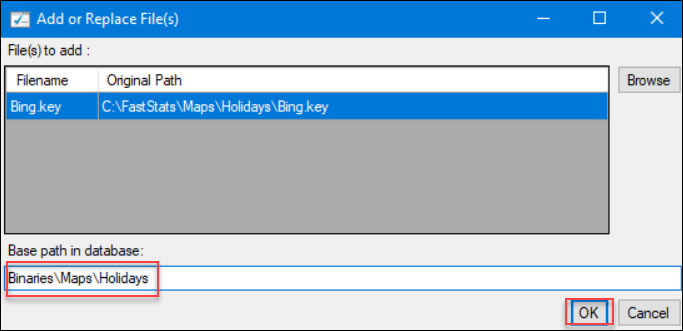
Bing.keyfile is now displayed within the Add or Replace File(s) menu window as a file to add. -
Insert Binaries\Maps into the Base path in database field (as shown below) and select OK.
-
The
Bing.keyfile is now displayed in the Customise Binaries window.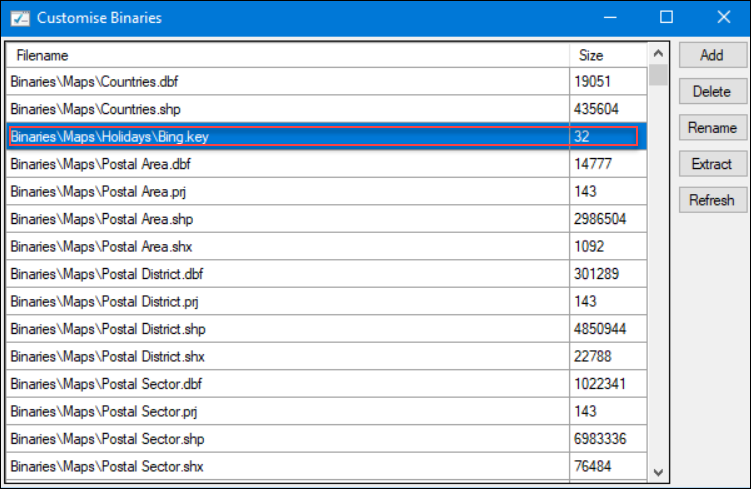
When the user next logs into Apteco FastStats, the Debug Log shows the following:

The Mapping Module is now available in the Toolbox ribbon bar.
