Supporting GDPR in your system
Check your version before you begin
From version Q1 2018 onwards, PeopleStage includes an administration tool for the General Data Protection Regulation (GDPR). For earlier versions, you can use the SQL scripts in Appendix A: GDPR SQL scripts instead.
If you're not using Cascade, PeopleStage, or the Response database, there is no need to do anything within the Apteco software.
Apteco and integrations
Apteco software has built-in functions to remove personal data. These functions don't apply to copies of data uploaded to downstream channels such as:
- Email broadcasting
- SMS messaging
- Social media platforms
- CRM systems
- Mobile push notifications
- Customer review platforms
- Programming languages
In each case, you'll need to use the functions offered by the channel provider to remove personal data from those systems.
Support a data subject's right to be forgotten
Article 17: Right to erasure: Upstream systems manage personal data and decide whether to include it in the data FastStats processes. If a data subject asks you to remove their information, and the source systems remove that data, FastStats removes that person too. This happens the next time the system reloads (typically daily).
GDPR Administration Tool
Apteco software attaches some information it creates to an identifiable person, such as campaigning activity in PeopleStage or responses gathered from email broadcasters. The GDPR Administration Tool in PeopleStage provides functions to manage this data.
These functions let you count, anonymise, or remove all instances of personal data related to a specified individual. Use them where PeopleStage or the Response databases hold the master copy.
First, add the GDPR Administration role to a user:
-
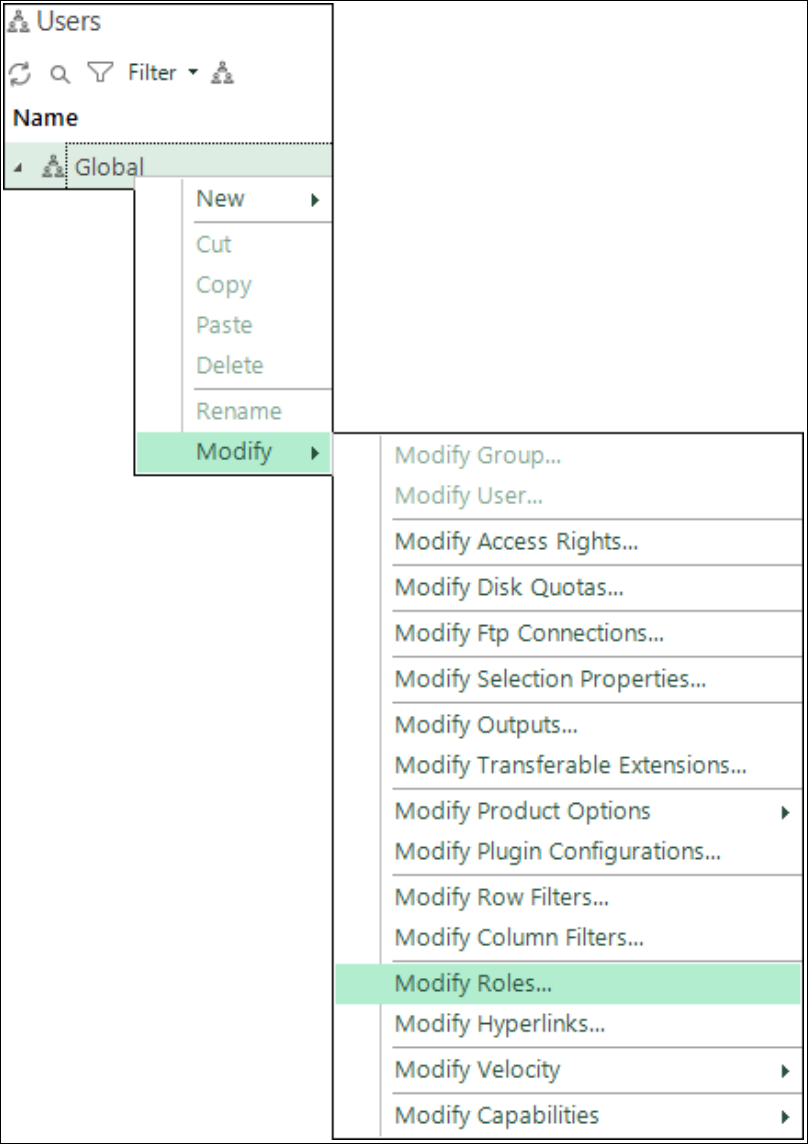
In FastStats, right-click on a user node and select Modify > Modify Roles.
-
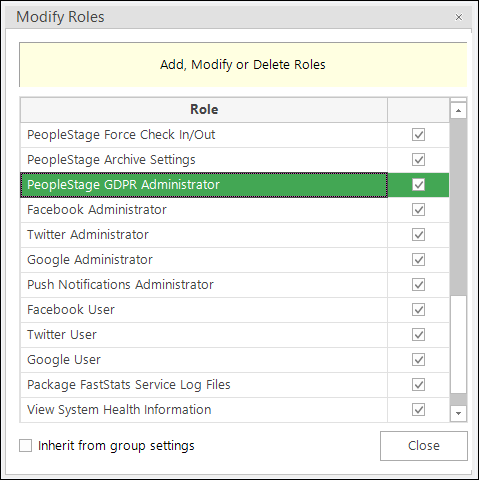
Select the PeopleStage GDPR Administrator check box.
The GDPR Administration Tool is available from the PeopleStage Administration menu. The dialogue provides strong data subject removal functions: you can anonymise the data in place or remove it entirely.
Note
For a full description of how to use the tool, see the PeopleStage GDPR Administration Tool knowledgebase article.
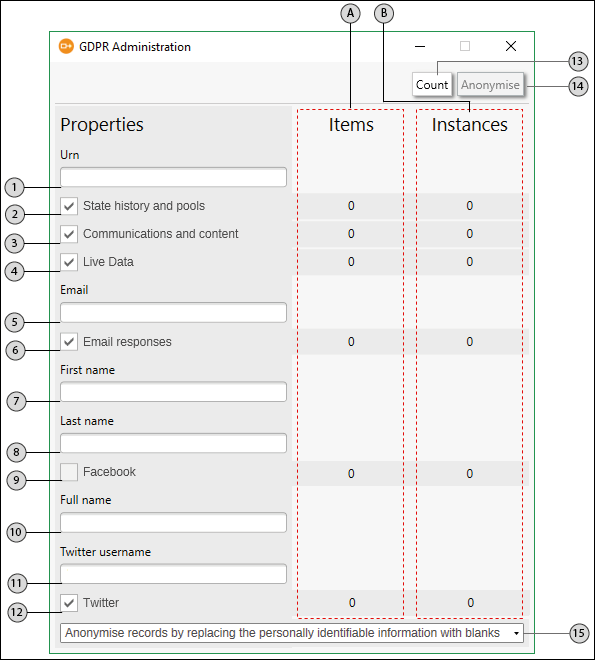
- A. Items: The number of records associated with the Unique Reference Number (URN).
- B. Instances: For example, one email record may have 40 messages.
| Item | Label | How it's used |
|---|---|---|
| 1 | URN | Enter the Unique Reference Number (URN) for the data subject |
| 2 | State history and pools | Data tracking where an individual has passed through a campaign and where they currently are in a pool. Select to replace with blanks (Anonymise) or delete (Remove) all data for the selected URN |
| 3 | Communications and content | Instances of data in the PeopleStage communication history, including content variations and attribute values |
| 4 | Live Data | Data retained by PeopleStage from external live data sources. When selected, PeopleStage removes the internal copy but doesn't cleanse data from the external live data sources |
| 5 | Enter the relevant email address | |
| 6 | Email responses | Select to anonymise or remove data from the Email response database for the selected URN |
| 7 | First name | Enter the Facebook first name (used to identify the data subject in the Facebook response database) |
| 8 | Last name | Enter the Facebook last name |
| 9 | Select to anonymise or remove data from the Facebook database for the selected URN | |
| 10 | Full name | Enter the Twitter full name |
| 11 | Twitter username | Enter the Twitter username |
| 12 | Select to anonymise or remove data from the Twitter database | |
| 13 | Count | Perform a count of the selected items |
| 14 | Process | Anonymise or remove the selected data |
| 15 | Anonymise or Remove | Anonymise: replace personally identifiable information with blanks. Remove: delete all records from the database, including reference numbers |
GDPR SQL scripts
If you're running a version earlier than Q1 2018, use the SQL scripts described in Appendix A: GDPR SQL scripts. They're essentially in pairs: one to provide a count and one to execute the script:
- Cascade Remove Count / Execute: communications records in the Cascade database
- Facebook Anonymise Count / Execute: Facebook users and attributes
- Facebook Remove Count / Execute: Facebook users and attributes (full delete)
- PeopleStage Remove Count / Execute: communications, tracking history, email responses, and live data
- Twitter Anonymise Count / Execute: Twitter user table records
- Twitter Remove Count / Execute: Twitter user table records (full delete)
Support a data subject's right to access
Article 15: Right to access: Any data subject can, at any time, request all the personal data you hold about them. Provide this in a common, clear format. The information you must supply includes:
- Confirmation that you are processing their data
- What information you hold on the data subject and how you are using it
- Other supplementary information (mostly the information provided in your privacy notice)
Data grids
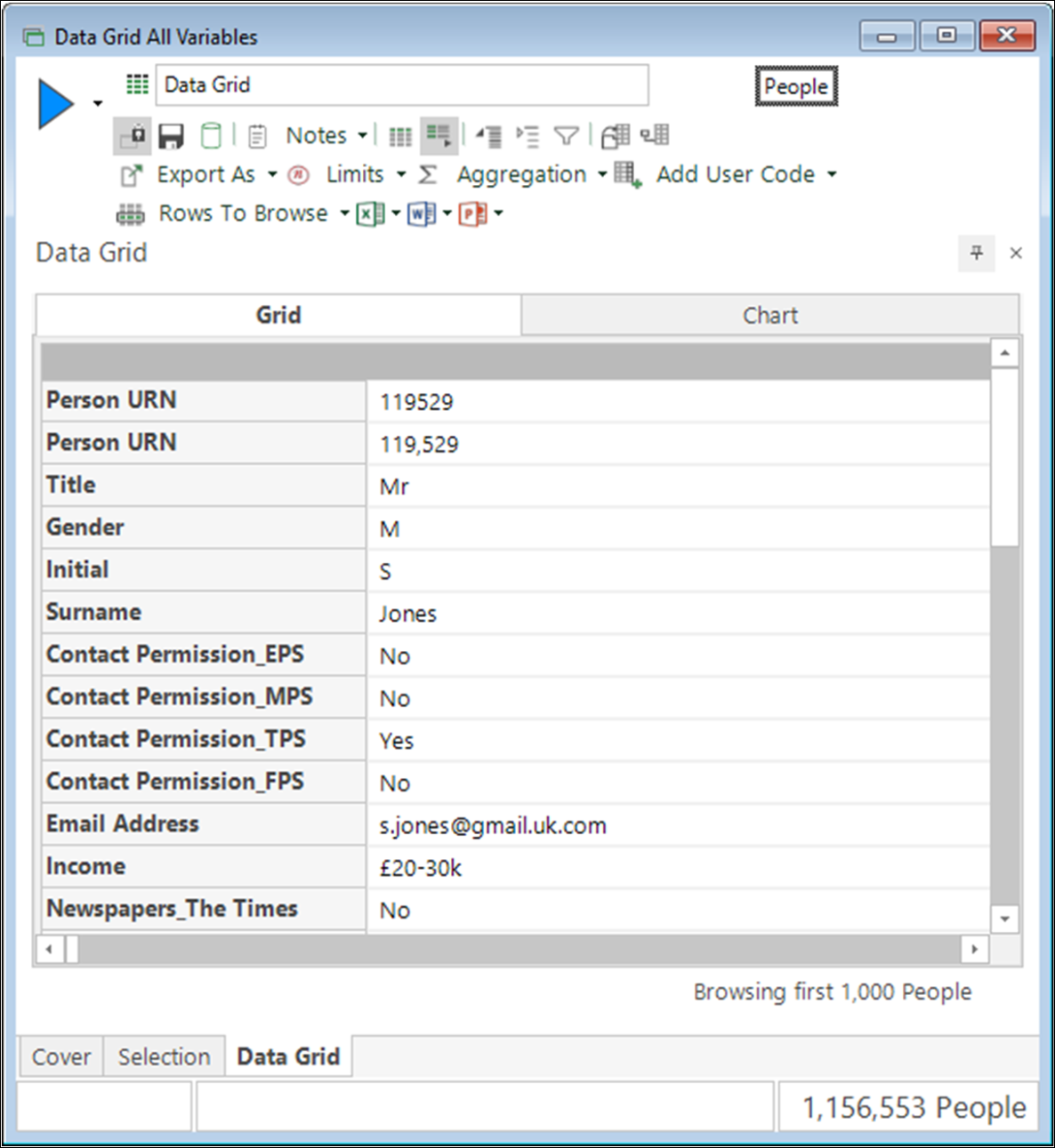
FastStats data grids provide a means to search for and identify personal data currently held:
- Limit the selection to the URN.
- Add all the variables to a data grid.
-
Select the Browse page view icon.
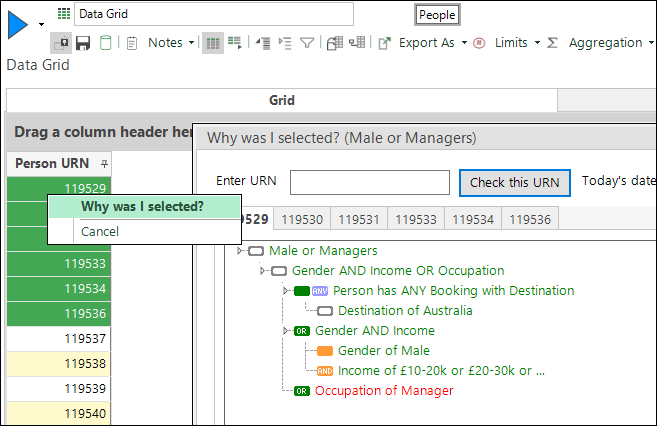
Why was I selected? function
The Why was I selected? function determines why the selection included a certain type of person. Right-click on a record in the data grid to see the menu option. Conditions marked in green are True. Conditions marked in red are False for the selected person.
Note
See the Data Grid: Enhanced Why Was I Selected knowledgebase article for more information.
Support a data subject's right to portability
Article 20: Right to portability: There are no clear guidelines on how to perform this. Transferring data to another organisation may not be possible, depending on the specificity of the data.
You can send copies to the data subject by exporting a data grid (described earlier) as a zipped, password-protected CSV file from FastStats.
Data transfer to another organisation could use the same process or an alternate secure method of data transfer.